 Church and Culture
A Different People “You are the light of the world.” “You are the salt of the earth” (Matt. 5:14, 13). “[O]nce you were darkness, but now you are light in the Lord” (Eph. 5:8). “We know that we have passed out of death into life….” (1 John 3:14). Throughout the New Testament, the followers of…
 Church and Culture
The Bible does not supply a roadmap for Mideast policy today. But there is a framework of principles that we can draw from the biblical story: We live in a world where the powerful build their empires by force, at the expense of the powerless. These regimes may be more or less oppressive, but…
 Church and Culture
The Middle East’s Christian minorities have a painful political history. Not only have they suffered persecution and restrictions at the hands of Muslim majorities, but they have also sometimes made poor choices themselves. One can find Arab Christian leaders who have championed democratic freedoms. For example, the Lebanese statesman Charles Malik (1906-1987) was a major…
Church and CultureThere is a widespread assumption that evangelical Protestant support for Israel is purely theological. But this assumption overlooks the many other reasons why evangelicals and other Americans feel an affinity with the Jewish state. It is true that the Bible weighs heavily in evangelical thinking. Most evangelicals, like most Christians of other traditions, believe that…
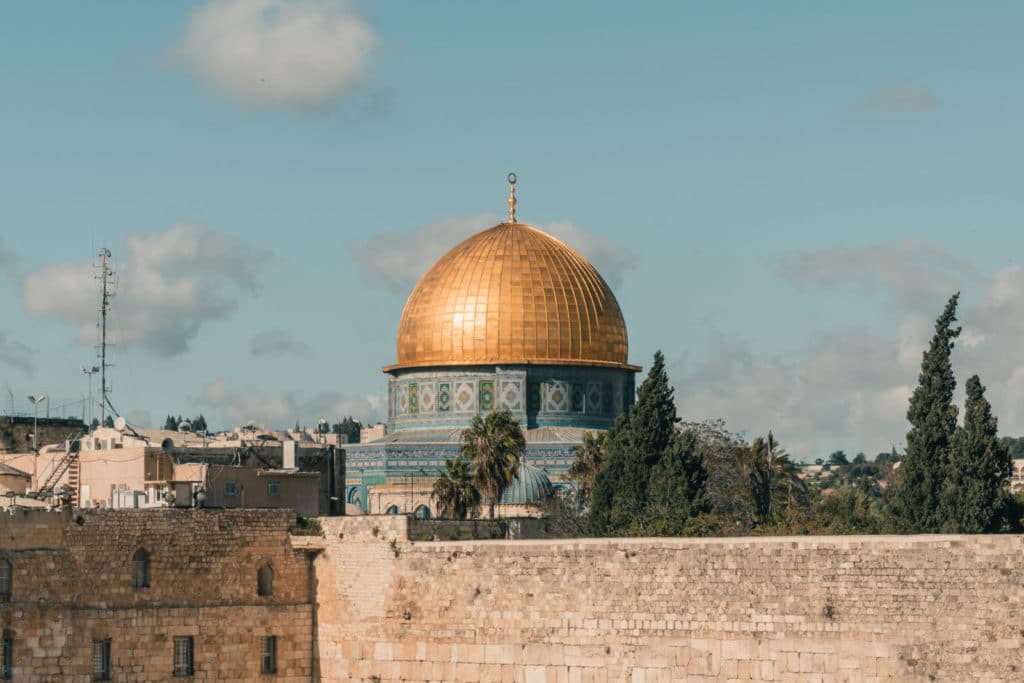
Church and CultureAnyone seeking to understand the Middle East cannot avoid this fact: it is the region where the events of the Bible took place. Jews remember God’s words and actions in what are now Iraq, Syria, Turkey, Jordan, Egypt, and Israel/Palestine. This is where God constituted them as a people, gave them a law to guide…
 Church and Culture
Within the larger question of the place of women in the New Testament, this passage is of critical importance. All across church history various voices have found “regimental colors” or even “battle cries” in these verses. One quickly thinks of: “the head of woman is man” and “any woman who prays…with her head unveiled, dishonors…
 Church and Culture
Paul tells the Corinthians (4:6) that his intent in this letter is, (literally translated) “that you may learn in us not to go beyond that which is scripture….” The Presbyterian Logo, as you recall, has a dove descending on a book. Our Reformed tradition rests solidly on sola scriptura. Out of this heritage I am…
 Church and Culture
What is marriage? Consider two competing views: Conjugal View: Marriage is the union of a man and a woman who make a permanent and exclusive commitment to each other of the type that is naturally (inherently) fulfilled by bearing and rearing children together. The spouses seal (consummate) and renew their union by conjugal acts—acts that…
Church and CultureThe church’s historic understanding of marriage may be the foremost doctrine under fire at the 220th General Assembly (2012) of the Presbyterian Church (U.S.A.). Redefining marriage is the next logical step in the normalization of sexual relationships outside the marriage of man and woman. With the 2011 deletion of the requirement that ordained PC(USA) officers…
 Church and Culture
These questions and answers are taken from Marriage on Trial: The Case Against Same-Sex Marriage and Parenting by Glenn T. Stanton and Bill Maier. Copyright © 2004 by Glenn T. Stanton and Bill Maier. Used by permission of InterVarsity Press PO Box 1400 Downers Grove, IL 60515. www.ivpress.com. Although we have omitted some questions, we…
