
In this essay
Why We Exist
A conference talk from Lorenzo Small on the church's reason for being. Not its programs, not its buildings, not its institutional momentum, but the underlying calling that holds every congregation accountable: the gospel its existence is meant to bear witness to.

Listen to this essay
ElevenLabs Audio Native player will render here once the embed is wired up.
Read by an AI voice generated by ElevenLabs


More from
 " alt="">
Holiness
St. Christina the Astonishing tried to flee the stench of sinners; Isaiah collapsed in terror before the Holy One. Sara Jane Nixon argues that the content of God’s holiness is love, a holiness that draws near to sinners rather than away from them.
 " alt="">
Orthodoxy
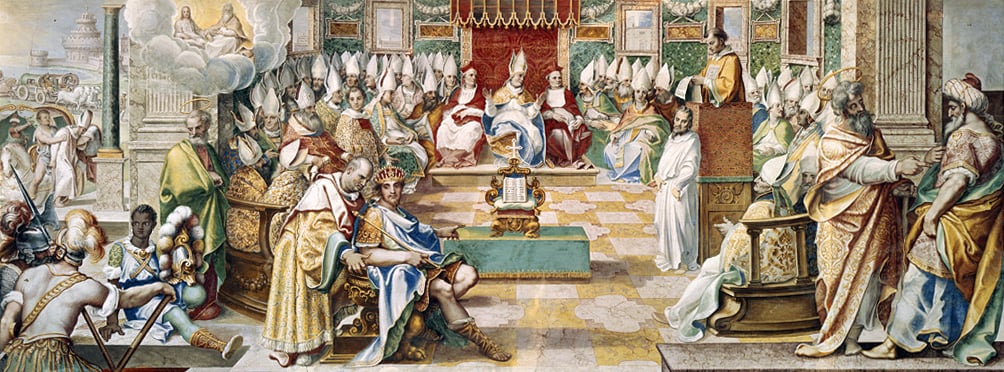
Right belief or right worship? Doctrine or doxology? Drawing on Chesterton, Athanasius, and Calvin, Richard Burnett presents orthodoxy as a costly, moving equilibrium, never stuffy and never still, that has carried the church through every storm.
 " alt="">
Perseverance
Spiritual autobiographies remind us how the Spirit sustains faith through the long road. Drawing on Schweitzer, C.S. Lewis, and J.R.R. Tolkien’s Lord of the Rings, Douglas F. Fletcher names ten weapons against evil and reflects on perseverance as a gift God himself secures.
Continue Reading
More Articles
 " alt="">
Canon: A Moving Target?
Bart Ehrman and Dan Brown have made the New Testament canon a contested question again, presenting it as a top-down decree imposed on the early church. Hobson goes back to the actual history and shows that councils didn't decide the canon; they recognized what had already become Scripture by use.
 " alt="">
Rediscovering the Office of Elder-The Shepherd Model, Part I
What does it mean to be an elder? Laverentz argues that for most of Presbyterian history, an elder was a shepherd of souls, deeply enmeshed in people's lives. Part one of his series looks at how that understanding has nearly disappeared in a single generation.
 " alt="">
Pastoral Ministry and Scholarship
Why insist that pastors be trained as scholars? La Montagne separates the Reformed tradition's actual answer from the modern research-university definition that's quietly replaced it, and shows how the original conception still serves congregations better than the institutional one.
 " alt="">
Identifying Boundaries
John Spong rejects monotheism, the incarnation, the Trinity, and the atonement, then claims to be a Christian. Cyre asks what content actually distinguishes Christian faith from anything else, and walks through Paul, Athanasius, and the Reformers for the kind of answer Spong's question demands.
 " alt="">
A Surprising Hope: Barren Wombs and Unexpected Fruitfulness
Billings preaches the biblical pattern of barren wombs becoming the very means by which God brings forth promise, from Sarah through Hannah to Elizabeth. A talk about waiting, hope, and the kind of fruitfulness that resists every category we try to put around it.
 " alt="">
An Invitation to Combat
Ray opens with a Boy Scout sea voyage to Austria as a fifteen-year-old, the moment a curious kid first met big questions. The address builds from that memory toward an invitation: theology as combat in the best sense, the place where serious questions actually get fought through.