


Rediscovering the Main Thing
by Edwin Hurley
1. What has been the greatest challenge for you as a minister during this crisis?
Separation from our congregation has been my greatest challenge. I am a people-person, and not being able to be with people of the congregation has been hard. While we have made regular efforts to reach out via phone to all members, there are many we are missing, or have only passing contact with. When we do make contact, however, there is always great appreciation felt. That separation is most keenly felt in absence of in-person worship, as we have mostly offered worship only through live distant broadcast. Funerals have been so different, either nothing being done near time of death or very small graveside services.
2. What do you think you and your congregation may have learned through this crisis?
We have learned of the resiliency of the church. Jesus nailed it when he told Peter, “The gates hell shall not prevail against it.” We have adapted in creative ways with small groups and other classes being offered on Zoom and worship services through live broadcasts on Sunday morning.
Providentially and independently of COVID, the very week we had to close the church last March new cameras and equipment were being installed through the generous gift of a member and former TV executive, so we were able to offer our first on-line service that very Sunday and have done so ever since. To paraphrase Martin Luther’s famous one-liner, “While I drink my little glass of Wittenberg beer, the gospel runs its course.” In other words, “While the Pandemic grips the world the gospel runs its course.” We have experienced just how durable the gospel and the church are.
3. What do you see as the greatest challenge facing your congregation in the future
People have grown accustomed to staying at home, worshiping in their PJ’s. We wonder how many will remain in this pattern? What will our re-opening look like? How will our future programing change? One fear that certainly did not materialize: We worried whether people would still give. But giving has remained steady and even increased, both in our regular budget and an emergency capital funds drive that was actually over-subscribed.
4. What good do you think might come from this crisis?
Our people have rediscovered the main thing. The purpose for which we exist is to worship the Living God and make and grow disciples of Jesus Christ. Peripheral programing has gone away. Much of our community outreach, such as AA, Sunday Club for the mentally challenged, etc., sadly, have had to be curtailed. Yet we have continued to worship and grow and learn new ways to reach out to our neighbors, such as our every Wednesday “Feed My Sheep” food ministry to the neighborhood. It is clear that people have a greater appreciation for their church through these hardships and recognize the difference this church is making in their lives and in the lives of our community and world.
5. What have been the greatest sources of encouragement for you during this crisis?
A few members have regularly called just to check on my wife Gayle and me, to see how we are doing. Sadly, I have buried two of the most regular callers. Being on the receiving end of congregational compassion and care has been uplifting. People have consistently stepped forward giving their time, talents, and treasure to a greater degree than before. On Easter Sunday I named some of our home-grown saints who have entered the life eternal recently. The connection of saints on earth and saints in heaven has been vivid for us.
I am inspired by the following lines by Dietrich Bonhoeffer written from prison to his infant nephew, Dietrich Bethge, upon his baptism:
Are we moving towards an age of colossal organizations and collective institutions, or will the desire of innumerable people for small, manageable, personal relationships be satisfied? Must they be mutually exclusive? … We may have to face events and changes that take no account of our wishes and our rights. But if so, we shall not give way to embittered and barren pride, but consciously submit to divine judgment, and so prove ourselves worthy to survive by identifying ourselves generously and unselfishly with the life of the community, and the suffering of our fellow-men”

Dietrich Bonhoeffer, Letters and Papers from Prison (p.299)
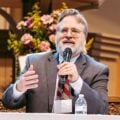
Edwin Hurley, D.Min., is Senior Pastor of South Highland Presbyterian Church (PCUSA), Birmingham, Alabama
 " alt="">
 " alt="">
 " alt="">
 " alt="">
 " alt="">
 " alt="">